
Managed by the Center for the Advancement of Science in Space™ (CASIS®) through a Cooperative Agreement with NASA since 2011
The ISS National Laboratory® allows companies, academia, nonprofits, and government agencies to leverage the unique space environment to conduct research not possible on Earth. The results benefit humanity, provide value to the nation, and enable a robust and sustainable space economy.
Who we are and what we do
Responsible for 50% of payloads on NASA cargo missions, 50% of astronaut crew time.
For the past three years, 80% of our research portfolio represents private-sector interests.
Our STEM/workforce development programs help inspire and train the future workforce.
Cumulative Impact of ISS National Lab
228
Industry Projects
L3Harris, Sanofi Pasteur, Eli Lilly, Procter and Gamble, Merck, Lockheed Martin, Target
248
Academic, nonprofit, & oga projects
UF, FIT, FIU, MIT, Stanford, Cornell, Notre Dame, LLNL, ORNL
320
MEMBER Investor Network
23
Commerical Lab Facilities
33
Implementation Partners
CSS, Boeing, Sierra Space, Aerospace, Bionetics, Leidos, Teledyne Brown
15
Commerical Service Providers
Axiom Space, Redwire, Blue Origin, Voyager Space
>800
Payloads
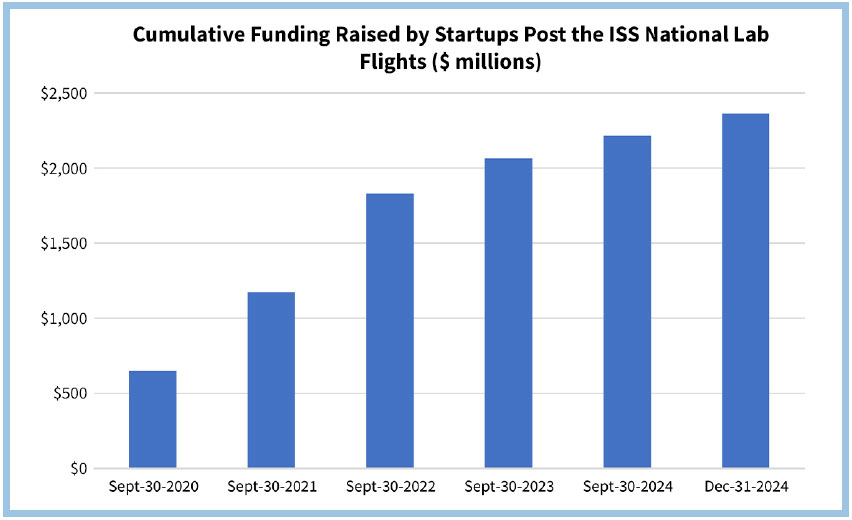
$2.2B
Cumulative funding raised by startups post-ISS National lab flights
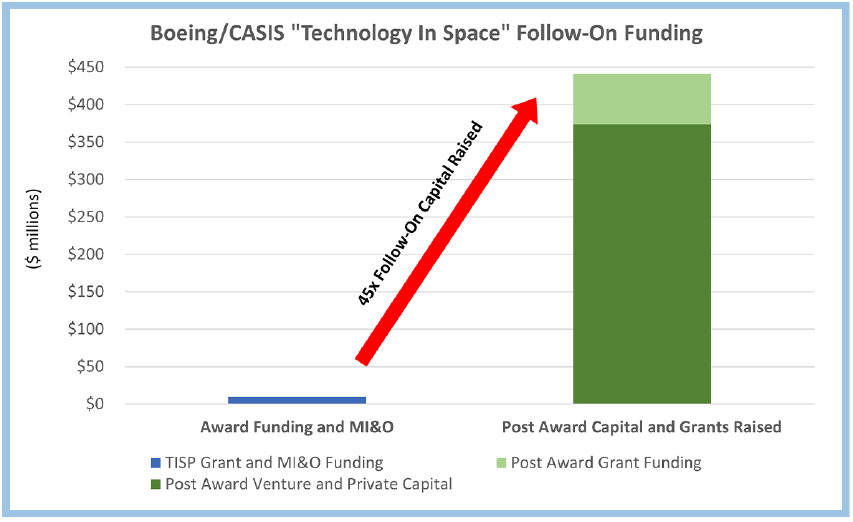
525M
$210M NASA
$315M External Funding
Gov’t Agency Funding Partners
DOD, NSF, NIH
ISS National Lab Financial Impact
Research results we have enabled
In-Space Production
- Crystal growth research is helping Merck improve the manufacture, storage, and drug delivery of its Keytruda® cancer therapy.
- Startup Axonis Therapeutics grew 3D brain organoids to test a new drug for neurological conditions and attracted $150 million in Series A financing following its flight projects.
Technology Development
- After validating its sensor technology, startup Orbital Sidekick attracted nearly $50 million in investment and signed more than a dozen energy companies for pipeline monitoring services.
- Hewlett Packard Enterprise demonstrated supercomputing in space using innovative software that protects hardware from extreme conditions and filed a patent relate to tis research.
Fundamental Science
- Case Western Reserve University advanced the understanding of flame behavior in confined spaces to improve fire safety models and prevent fire-related tragedies.
- Stanford University used stem cell-derived heart muscle cells to study cardiac function at the cellular level, laying a foundation for more advanced studies to improve heart disease models.